
The Wall Street Journal reported today that with inflation remaining stubborn, the Federal Reserve could raise its benchmark interest rate at its December 2026 or January 2027 meeting—or potentially at both. Those increases are possibilities, not decisions. Mortgage rates do not move in lockstep with Fed rates, but inflation and expectations for Fed policy can affect borrowing costs.
In a real estate market that is already slowing because of higher rates, this can mean more of a drag. So before making an offer, get with your agent and lender and look at options that can have a bigger impact, or the same or near the same impact, on the seller rather than just assuming a price reduction.
Three ways to negotiate
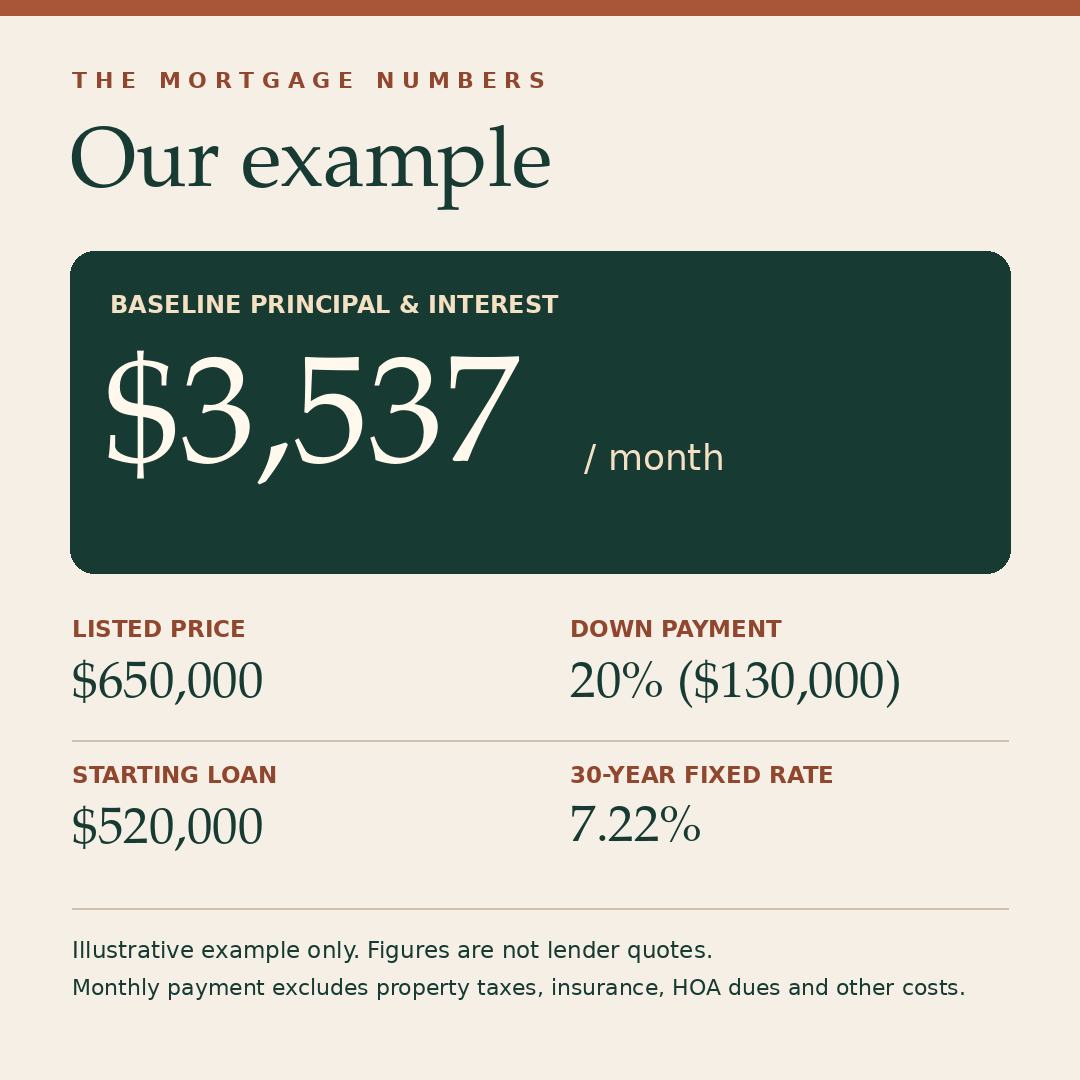
Using an example of a house asking $650,000, let’s look at 3 tactics and the impact of each on the buyer and the seller:
#1 Reduce the purchase price by $10,000
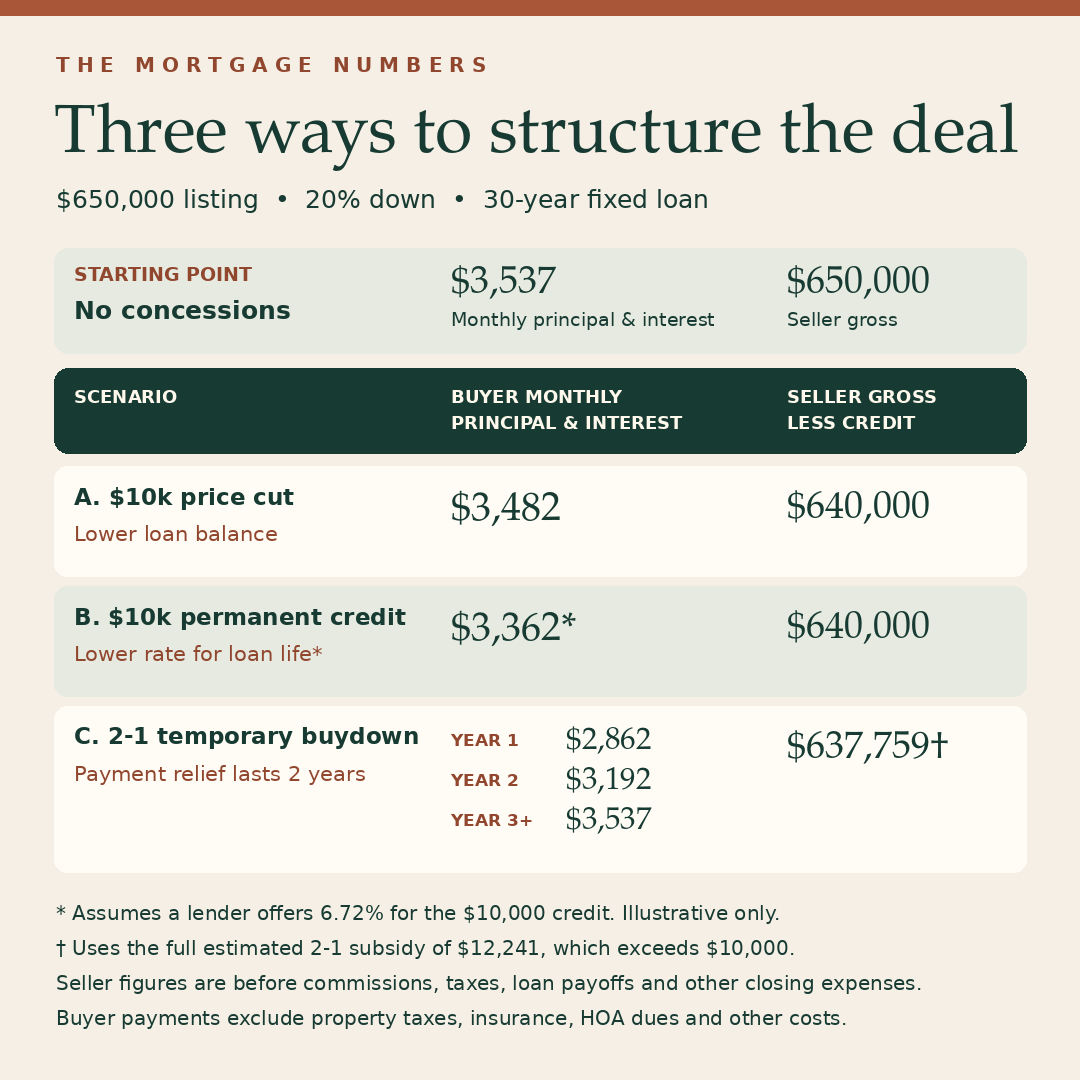
The buyer pays $640,000 and puts 20% down ($128,000), financing $512,000. At 7.22%, principal and interest falls to $3,482/month—about $54 less than the original payment on a $650,000 sale price. The seller receives $640,000 before other selling expenses.
#2 Seller contributes $10,000 to a permanent rate buydown
The price remains $650,000 and the loan remains $520,000. The seller provides a $10,000 financing credit, subject to lender rules. If—and only if—the lender quotes a permanent rate of 6.72% for that credit (a hypothetical half-point reduction), principal and interest would be $3,362/month, saving about $174/month for as long as the buyer keeps that loan. The seller receives $640,000 before other selling expenses. The actual rate available for $10,000 must be confirmed by the lender.
#3 Seller funds a temporary 2-1 buydown
The price and note rate remain $650,000 and 7.22%. A 2-1 buydown subsidizes payments as if the rate were 5.22% in year one ($2,862/month) and 6.22% in year two ($3,192/month); the full 7.22% payment ($3,537/month) begins in year three. The buyer generally must qualify at the full note rate.
Estimated required subsidy: $12,241 for the first 24 payments—not $10,000. If the seller pays the entire estimated subsidy, seller proceeds before other selling expenses would be about $637,759. The lender must verify the actual subsidy, escrow, and program requirements. The seller would net less, and the buyer’s savings in year 3 would diminish, but the buyer has saved. Over time (if the buyer does not refinance at a lower rate), this is the less attractive of the options because the 2-1 buydown saves approximately $10,935 during the first two years.
The buyer then pays approximately $18,282 more over the remaining 28 years.
Net result: the 2-1 buydown costs approximately $7,347 more in total mortgage payments than purchasing at $640,000.
The buyer also puts $2,000 more down at closing, bringing the total additional cash outlay to approximately $9,347 over 30 years. The higher down payment also creates additional home equity, so it is not entirely an economic loss.
What about the seller? The 2-1 buydown in this example costs approximately $12,241, not $10,000.
What does this mean for each side?
For the buyer: A $10,000 price reduction produces a relatively modest monthly savings. A permanent buydown may deliver greater ongoing savings, depending on the lender’s pricing. A 2-1 buydown provides the largest initial payment relief in this illustration, but payments rise in years two and three.
For the seller: A $10,000 price reduction and a $10,000 seller credit have the same simple dollar effect on gross proceeds in this example, although actual closing costs can differ. A full 2-1 buydown costs more here, so it should not be presented as an equal-cost alternative without adjusting the credit or renegotiating terms.
The practical takeaway
The strongest negotiation is not always to lower the sale price. Ask the buyer’s lender to quote all three structures on the same day, including the permanent rate achievable with a specified credit, the exact 2-1 subsidy, cash needed to close, and qualification requirements. Then compare monthly affordability, seller net, and how long the buyer expects to keep the mortgage.
Financing note: Seller-paid concessions and discount points are subject to loan-program limits, appraisal support, and lender approval. A temporary buydown does not change the underlying note rate. A refinance could shorten the benefit of an upfront permanent buydown.